|
|
| ||||
|
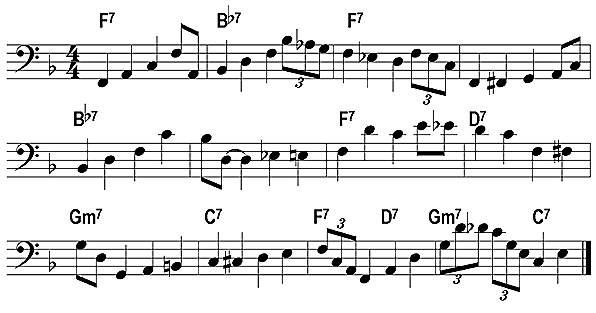
There are various embellishments such as drops, climbs, rakes, grace notes, hammer-ons and pull-offs. These are all techniques which can improve your playing by adding variety and enhancing the rhythm. DropsDrops are drops in register, usually executed quickly, using either a grace note, two swung eighth-notes, or a group of one or more eighth-note triplets. Example U1 demonstrates drops within a two-octave range overall. Example U1
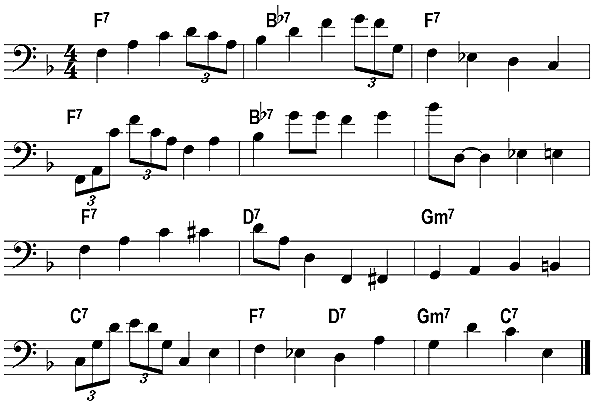
ClimbsExample U2 demonstrates climbs and drops in an extreme fashion, using quick register changes. Example U2
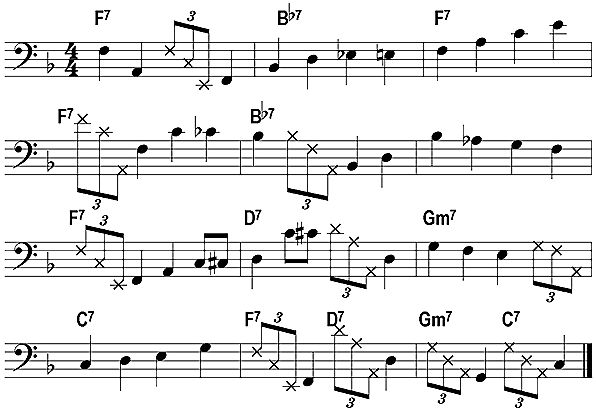
Climbs and drops are usually made up of chord tones and should be practised as arpeggios. RakesA further technique used in drops is the rake. This technique is derived from the triplet drop and is used predominantly at faster tempos, especially when it is difficult to articulate all of the desired arpeggio notes. The strings are muted with the left-hand fingers while one or more of the right-hand fingers 'rakes' the strings from high to low, then landing strongly on the desired note. This creates a strong sense of rhythmic drive. The raked notes are noted with the symbol "x" indicating an undefined, muted pitch. Example U3 uses string rakes. The number of rakes in this example is far too many; but it does demonstrate where rakes can be used: on beats 1, 2, 3, or 4 - anywhere! Example U3
Grace NotesA further type of embellishment is the grace note, often called skip or kick note. Grace notes, depending on the intended feel, are usually placed just before the beat and can be either ghost notes (muted) or pitched notes, including hammer-ons and pull-offs. Here are some practice methods to learn the various grace note techniques: First, play a descending C major scale while kicking off the adjacent open string below the one on which the next scale tone is to be played. Use the 1st (shorter) finger of the right hand for the grace note and the 2nd (longer) finger for the pitched note. Example U4
Transfer this exercise to different positions on the other strings making sure the grace note is always kicked off the adjacent lower string. Of course, do this type of exercise with any group of notes, for example chromatic or arpeggio note groupings. If the time between the grace note and the pitched note is fast enough, then the pitch of the string on which the grace note is played will be barely audible, as the 2nd right-hand finger immediately rests on the lower string, therefore muting it. Ghost NotesNow attempt playing the grace note on the muted string on which the next pitched note is played. To do this, you will have to alternate muted open strings with stopped notes. Alternate right-hand fingers as well. Example U5
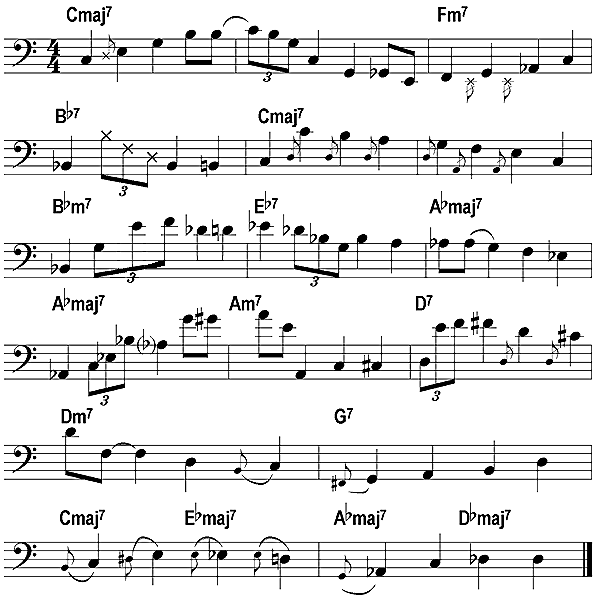
Of course, make up your own permutations of this exercise. The two discussed grace note techniques can be combined to create the most comfortable playing method. Grace notes can also be hammered on and pulled off as shown in Example U6. The hammer-ons or pull-offs can also be part of a triplet group, usually the last swung eighth note. This example uses drops, climbs, rakes, grace notes, hammer-ons and pull-offs. The embellishments in this example are far too numerous. Use embellishments with taste so as not to destroy the groove. Then they will work in a positive way, creating natural forward motion. Example U6
Walking bass is a very involved area in music theory. See also: |