|
|
| ||||
|
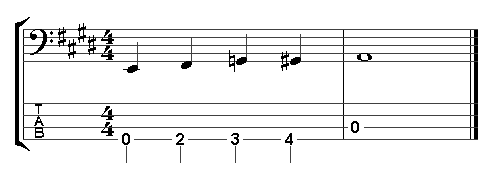
Jazz was originally played on acoustic, upright basses which have a different tone to the electric bass. Some electric players use flatwound strings like on acoustic basses as they have a warmer tone. A reduction in tone can also be obtained by turning the tone control down or by positioning your right hand closer to the neck. Tone is said to be about 60% technique / 40% equipment. Jazz usually involves swing rhythms although many Jazz bands include Latin tunes in their repertoire. The examples in this Jazz section are to help bassists who are new to jazz to learn some easier walking lines as an introduction to what is a very involved area in music theory. There are links at the bottom of this page which provide a detailed treatment of walking bass, all notated using standard notation. These same links are also listed in the theory menu except for the section on embellishments which deals with techniques. Walking BassThe purpose of walking bass is to play the quarter-note pulse on which the music is based, linking that rhythm with the harmony - outlining the chords. This therefore creates continual rhythmic motion, freeing drummers from their traditional strict time-keeping role, thus enabling their interaction with soloists and harmony players. The technique of walking bass became prominent in the 1940s. Before that period the bass usually played a "half-time feel" (two beats per bar in 4/4 time) that created a more settled, start-stop, less driving effect. Walking bass is the main concept in playing Jazz bass. A walking line is a quarter note swing rhythm outlining the chord progression. Most blues lines are walking lines as they function in the same way. In terms of choosing which notes to play the main consideration is to outline the chords using the notes from that chord (chord tones). Playing such notes for each chord would sound more like a series of arpeggios so passing notes are often used to make a smoother transition between the chords. Passing notes are usually chromatic notes between chord tones. The other commonly used notes are from the scale which each chord belongs to so these notes are known as scale tones. You need to understand modes to know what these scales are. e.g. One bar of E7 going to A7 could be:
E The root note. The G# in that progression was a very important note as it was played immediately before the chord change. Refer to the section on leading notes to see which other notes lead strongly into chord changes. Example D1
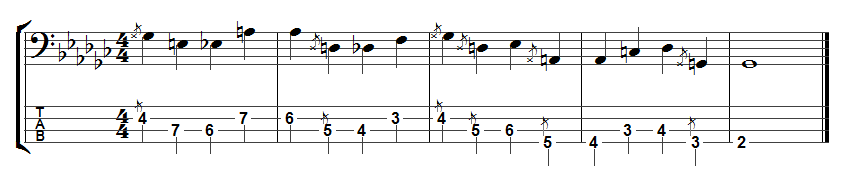
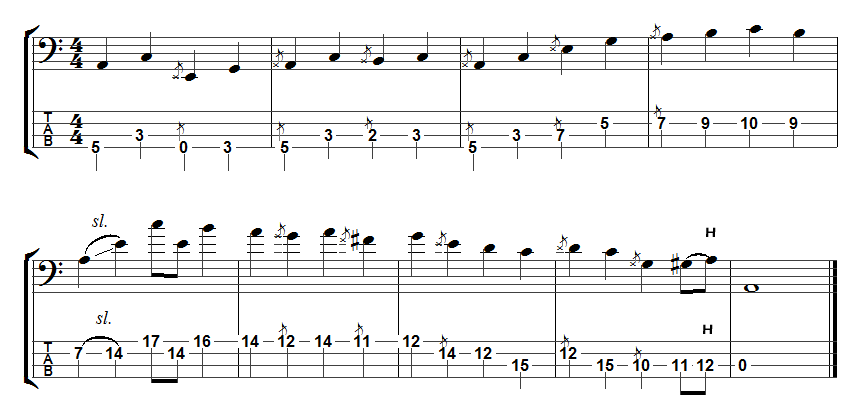
Example D1 uses ghost notes. These help to create the right feel by creating a closer link with the drums.The scale degrees for this chord progression are I VI II V in Gb. Each of these notes is played but as there are two chords per bar, there is not really time to worry about playing 3rds, 5ths or 7ths. Leading notes are used to join up the root notes over the two bars. During the second bar I play lower notes but they still follow the same progression. The tempo is fairly fast at 180 BPM. Modal walking bassChord progressions vary as to how many chords are in each bar. Sometimes you might have four chords per bar which only allows room to play the root notes. Jazz trumpeter Miles Davis was one of the first to write tunes which stayed on the same chord for many bars. This creates an opportunity to play a wider variety of notes drawing from the chord and also the other notes of the mode which correspond to that chord (ie. scale tones). Example D2
Example D2 stays in Amin the whole time. I use A dorian. Example D3
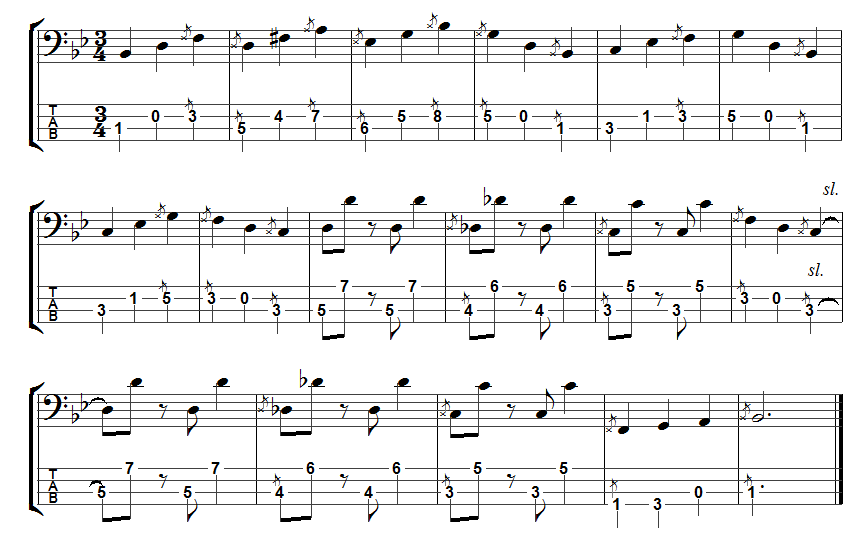
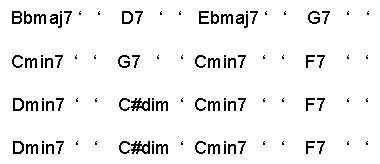
Example D3 has three beats per bar yet retains a swing feel. Many of the chords are not diatonic such as the D7 and the G7. I am also using ghost notes to help keep the feel lively. For the last eight bars I use a different rhythm and octaves to add variety. This also emphasizes the chromatic passage of Dmin7, C#dim and Cmin7. The chord progression is as follows:
Walking bass is a very important area to master to become a well rounded bass player. There are another 127 examples of Jazz bass in the following sections on walking bass:
|