|
|
| ||||
|
A leading note is a bass note played immediately before a chord change which leads into the new chord. If the chord progression is static then a leading note can still be used to enhance that stability. Leading notes are best learnt as intervals. An interval is the distance between two notes. Knowing the leading note intervals will give you some options to choose a strong note to lead into the new chord. There are five leading note intervals. The new chord in the next five examples is F so each example shows a different way to lead into that F:
Leading notes are the notes most commonly used to connect chords. After an analysis of ten representative bass players spanning fifty years of walking bass, the following statistics have emerged:
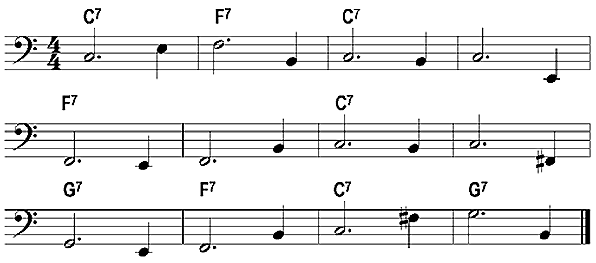
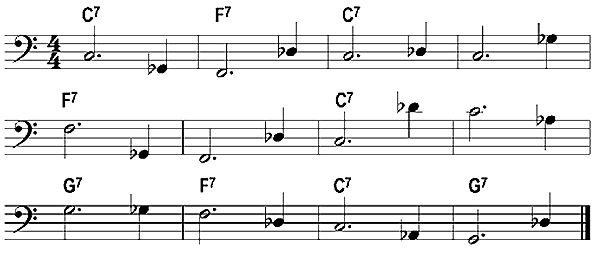
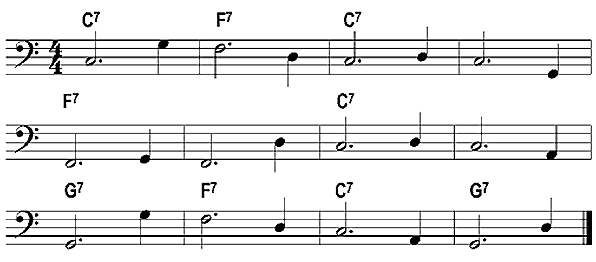
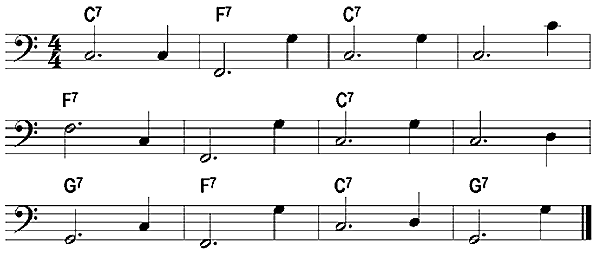
Which leading note interval should you use? Each has its own sound. Listen to the next five examples to hear these sounds for yourself. They are skeletons of bass lines over a three-chord blues in C. Each 12-bar chorus employs a different leading-note interval throughout. Example N1 (ascending perfect fourth)
Example N2 (ascending minor second)
Example N3 (descending minor second)
Example N4 (descending major second)
Example N5 (descending perfect fifth)
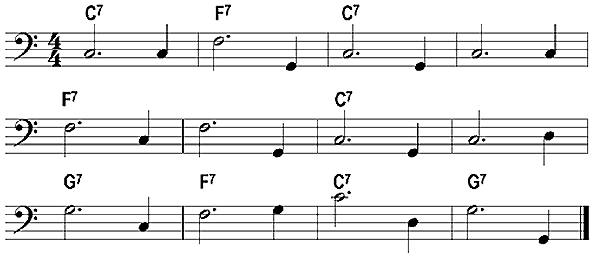
This example employs all five leading-note intervals. Example N6
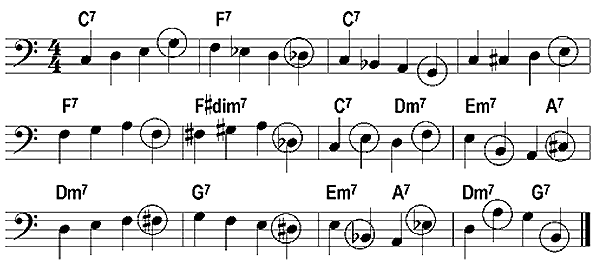
Here is a jazz blues that uses leading notes to connect all chords. Example N7
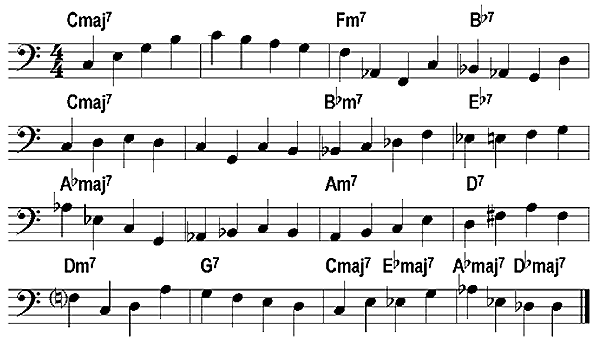
Leading Note CategoriesThere are three leading note categories, prioritized in order of consonance. Category 1: The leading note is a chord tone of the approach chord and is therefore consonant. Category 2: The leading note is another scale tone of the approach chord and is therefore reasonably consonant. Category 3: The leading note is not a scale tone of the approach chord but is one of the four leading notes. The necessity to use Category 3 leading notes is rare. They are best used as passing tones between Category 1 and Category 2 leading notes and resolution points (usually root notes). This is an example of a walking bass line, employing Category 1 and 2 leading notes to connect chords and bars. Note that all bars begin with chord roots except bar 13, which begins on the 3rd of the chord. It is common to connect major 3rds to minor 3rds when changing from a major to a minor chord of the same root. Example N8
Walking bass is a very involved area in music theory. See also: |