|
|
| ||||
|
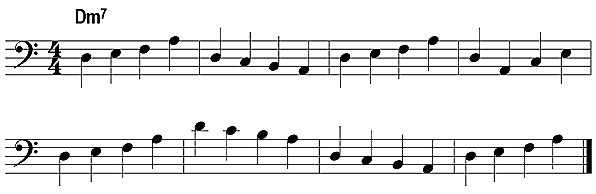
Playing modally, i.e. to play over one chord scale for a longer period is an integral element of modern jazz. Here too, the bass has to set up the harmonic field, especially the tonal center with leading notes. However, because there are very few truly functional chord changes (i.e. chords indicating different key centers), the bass is at liberty to play longer phrases. Let's begin with one-bar phrases in D Dorian mode. Example T1
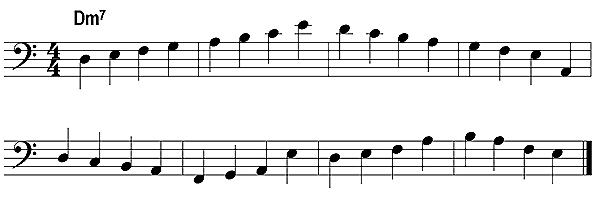
In Example T1 the bass plays the D root on the first beat of every bar and an A or E on the last beat of every bar. This has two effects: 1) To set up the D tonality Example T2
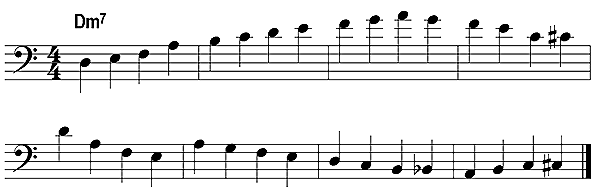
In Example T2 the bass plays the root of the chord scale (D Dorian) on the first beat of every other bar (Bars 1, 3, 5, and 7) with a leading note on the last beat of bars 2, 4, 6, and 8 to indicate a superimposed dominant (V) triad. Example T3
Example T3 uses longer phrases, with the occasional use of non-scale-tone leading notes (i.e. outside the mode). This creates more tension, but before it's too late the line resolves to the tonic. Also, note that the root D is used on beat 1 in three out of eight bars only. Now play the previous three examples consecutively and observe the developmental process within these twenty-four bars. This development is comprised of three simple ideas - one-bar phrases, two-bar phrases and irregular phrases with additional chromatics - strung together. To make modal lines sound interesting and not too repetitive, it is imperative that you have a strong idea for each segment within the form, i.e. play the form within the form using simple building blocks like target notes, superimposed V- chords and phrase lengths. If you use this information wisely and experimentally, and practise these techniques in all modes in all keys, you will have no problems coming up with fresh ideas. Walking bass is a very involved area in music theory. See also: |