|
|
| ||||
|
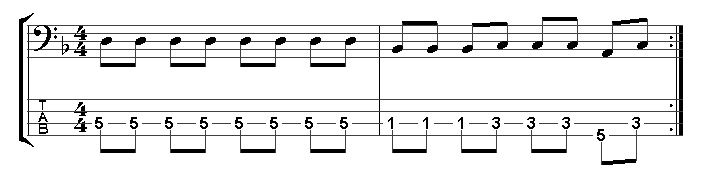
The most common rhythmic patterns in rock involve quarter notes and eighth notes. Rock is often considered to be an easy style to play but even simple bass lines must be played convincingly if they are to really drive a song. Mastering this style will not make you the eighth-note wonder of the world but you will be in demand as a bassist when you can make the music sound good. A great example of a rock bass line is Duff McKagan's line on Sweet Child O' Mine by Guns N' Roses. He takes a mid-tempo song with fairly routine chord changes and makes it interesting by using tasteful variations. Example A1 is played using eighth notes following the chord progression. These notes are played using the rest-stroke technique but a pick would work equally well. Example A1 - Dmin ‘ ‘ ‘ Bb ‘ C ‘ (eighth notes)
Quarter notes (also called crotchets) involve playing only four notes per bar in 4/4 time but these notes must be cut short if they are to sit tightly with the drums. Refer to the technique section on quarter notes under rest-stroke if you don’t know how to do this. Example A2 - Dmin ‘ ‘ ‘ Bb ‘ C ‘ (quarter notes)A pedal note is where is the bass stays on a note without following the chord changes. This creates tension in the song which adds a nice effect at times. A pedal note for the previous chord progression could involve playing a D over all three chords. This D could be played as an open string or a fretted note. Each has a different tone. It is generally better to go for the fretted note as a bigger sound is produced. Try practicing with the following backing track in at least these four ways: 1. Eighth notes following the changes (as in Example A1). 2. Quarter notes following the changes (Example A2). 3. Eighth notes staying on D. (Example A3). 4. Quarter notes staying on D. (Example A4). Anticipated NotesMany songs have the chords changing in places other than on the beat. A common way of doing this is by anticipating the changes so they occur earlier. The following example uses the same chords as the previous example but has the changes happening earlier. Eighth notes are still used but there are only three Bb notes instead of four. It also changes back to the note D before the start of the next bar. Rock ballads often use these anticipated notes. Example A5 - Dmin ‘ ‘ ‘ Bb ‘ C ‘
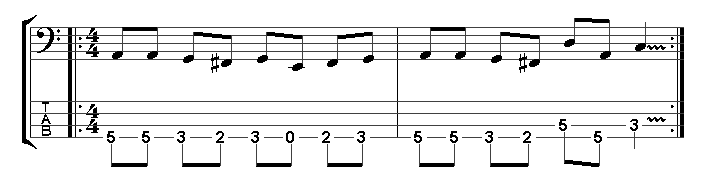
The previous bass lines followed the chord progression closely using root notes. Example A6
This example is a riff. Bass lines which are riffs can generally be copyrighted because they are deemed to be creations which have their own identity. This riff is played using the rest-stroke technique. Players who like using a pick would generally do so for rock riffs for a big sound with plenty of attack. Example A7Try writing your own riff for the following jamming spot. The progression is:
E ‘ ‘ D D ‘ ‘ ‘ D ‘ ‘ D/C# D/C# ‘ ‘ ‘ Example A8
In this funk/rock example the bass functions as the backbone of the rhythm section, providing space for the drums to branch out. The bass and drums also sit closer together through the use of ghost notes. There is no bass on the first beat of most bars. This is uncommon as the first beat is very important. By doing this the drums are emphasized. Example A9
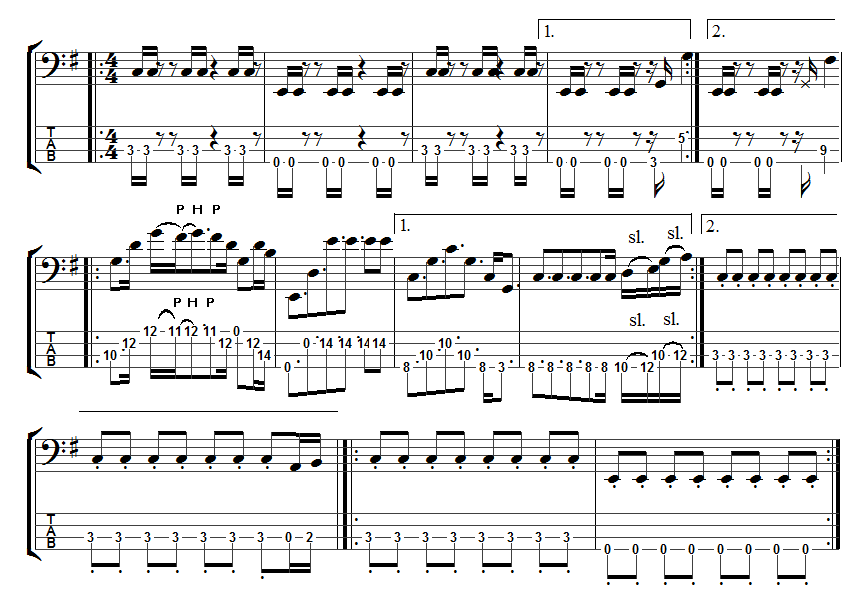
This example was recorded with Melbourne band The Need. The verses are heavily syncopated with guitar and bass playing the same rhythm. The bass becomes more melodic in the pre-chorus using a combination of open strings and pull-offs. The chorus is a slow pump using eighth notes which is actually harder to keep accurate at slow tempos such as this. Example A10Wired 1989.
Example A10 uses a Hipshot in the intro and verses to quickly access a low D. I have included the whole song as a common challenge for Bass players in Rock bands, i.e. what to do when faced with yet another medium tempo song in common time. It's easy to just provide an eighth note pump following the changes but it's always nice to find subtle variations. Rather than notate any particular section, note the following variations:
|