|
|
| ||||
|
Larry Graham is often credited as the originator of the slap technique. He used his thumb to simulate the bass drum and his index finger to simulate the snare. Slap is a very rhythmic technique which fits tightly with the drums or can sound full on its own. Slap (thumb)
Here are the steps involved with using your thumb to slap:
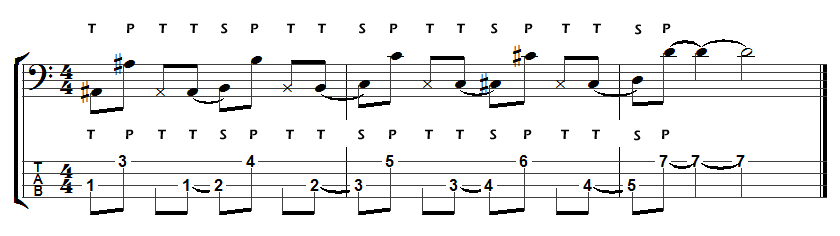
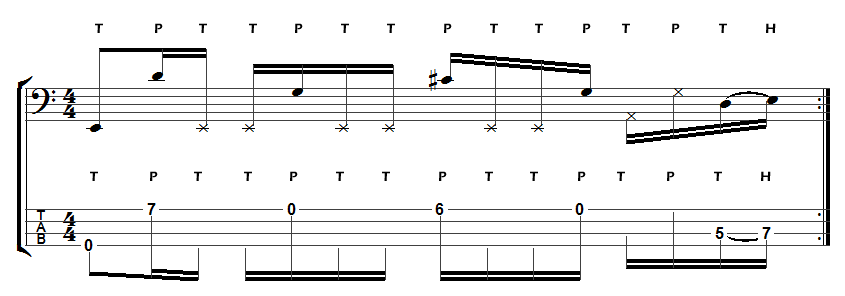
Thumb slaps are notated with a capital T to indicate that you use your thumb. (Note that a T can also be used to indicate finger tapping. It should be clear from the context which technique is required). Slap (fingers)
This technique is often called popping or plucking. Lifting the strings up and letting them snap back onto the neck is fairly straight forward. You must lift the string up higher than than its normal position to produce a decent sound. You can't get that snapping sound any other way so don't be tentative about this technique. String breakage shouldn't be a problem if you're sensible. Pops are notated with a capital P to indicate that you pop the note. (Note that a P can also be used to indicate a pull-off. Pull-offs may also be written as PO to avoid confusion. It should be clear from the context which technique is required). Ghost-notes can also be produced whilst slapping if a string is held lightly with the left hand. There are more slap examples in the Funk section.
This develops a common rhythmic pattern where there are two thumb slaps for every pluck. |