|
|
| ||||
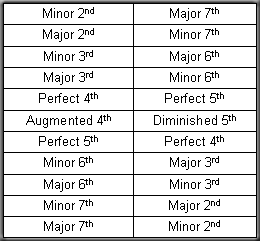
The Relative MinorEvery major key has a corresponding minor key called the relative minor. The relative minor is a complementary interval. The relative minor is the Aeolian mode which is a major sixth above the root note. The relative minor contains all the same notes as the major key. e.g. C major and A minor have all the same notes. If a song is based around C it is called C but if it is based around Amin it is called A minor. Complementary IntervalsAn interval is the distance between two notes. Complementary intervals are intervals which are of the same letter name but in a different direction (ascending or descending). This idea of complementary intervals works for other notes too. e.g. moving up a 2nd from E to F# is the same as moving down a minor 7th. All such equations add up to 9. The complementary intervals that fit this pattern are:
These interval pairs are just another way of seeing that musical notes continue in a cycle of repeating letter names instead of continuing on. This is why there are no such notes as H, I or J. For example, if you are on a D note and you want to go to an A, you can either go up a 5th to the A above or down a 4th to the A below. There is more information about the relative minor in the Key signatures animation in the section on the Circle of 5ths. |