|
|
| ||||
|
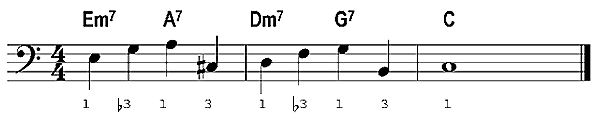
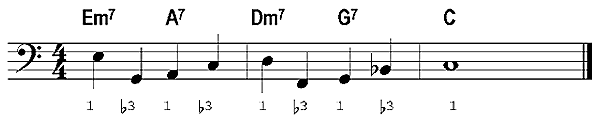
An important and widely used harmonic concept in Jazz is the turnaround. It is imperative for the player of walking bass to be able to deal with turnarounds instantaneously in the most suitable musical way. This segment gives insight into ways of dealing with turnaround patterns. A turnaround is a chord cycle usually leading to the tonic. The cycle usually contains four different chords, most often played within two or four bars. A common turnaround is the 3 6 2 5, generally noted as IIIm7 VI7 IIm7 V7, played within two bars. In the key of C, the chords are Em7 A7 Dm7 G7. To give an indication of the harmonic field (in the key of C) play the following root notes only, with an even pulse: E E A A D D G G C. The following system, in 4/4 time, always uses the roots of the chords where they fall (i.e. on beats 1 and 3); beats 2 and 4 are leading notes and chord tones. The system employs an intervallic approach, beginning with roots and 5ths (which are then inverted and altered) and continues with roots and 3rds (which are then also inverted and altered). Only 3rds and 5ths are used to approach the next chord root. The 7th of each chord would naturally resolve to the 3rd of the next chord, creating a false harmonic impression. This pertains especially to the bass register and is therefore not used. Play this example. Note how the line ascends and descends naturally in each bar. The numbers under the notes are the chord tones, i.e. intervalically speaking 1 = the root, 5 = the 5th. Example R1
Example R2
Example R2 has the same chord tones as Example R1 but is an inversion (descending, ascending). Example R3
Example R3 employs the b5 on both minor chords. (Note that if they were both m7b5 chords, then this would be a 1st category leading note.) Example R4
This is an inversion of Example R3. Example R5
Example R6
Examples R5 and R6 employ the b5 on the V7 chords. Example R7
Example R8
Examples R7 and R8 have a b5 on all chords and are therefore, arguably, the most "jazzy" examples so far. The previous eight examples show eight different ways of playing over the same turnaround. If, however, we combine the first bar of the first example with the second bar of the second example, e.g., then go through all combinations, we'll find sixty-four possibilities. That is sixty-four ways of playing over the same turnaround using only the root and 5th of each chord. This system in all twelve keys yields 768 possibilities. The following eight examples use the 3rds as approach/leading notes. Example R9
Example R10
Examples R9 and R10 use the "correct" 3rds. Note that the ascending/descending or descending quality of the line has been retained. This creates a better balance as opposed to going in one direction for the entire bar. Example R11
Example R12
Examples R11 and R12 use the major 3rd on the minor chord. This works at medium to fast tempos. Example R13
Example R14
Examples R13 and R14 have the correct 3rd on the minor chord (this 3rd is now an approach note and not a leading note.) The V7 chord has a b3 (or, more correctly a #9) as the approach note. This is a very common note choice for the highly alterable dominant 7 (V7) chord. Example R15
Example R16
Examples R15 and R16 have a major 3rd on the minor chord and a minor 3rd on the major, V7 chord. Sixty-four combinations are available in each key, creating a total of 768 possibilities in all twelve keys. Try combining the 3rds with the 5ths in one-bar or half-bar formats. You will see that there is plenty to work with. In fact, there are 65,536 possible combinations in one key alone! Therefore investigate and get beyond playing patterned turnaround lines. It is important to understand the system and to employ what you hear to be the most appropriate combination of notes at any given musical moment. All examples were based on one turnaround pattern only. I strongly urge you to explore further possibilities using the same or similar guidelines. Ultimately, the best way of learning is to find out for yourself. Walking bass is a very involved area in music theory. See also: |