|
|
| ||||
|
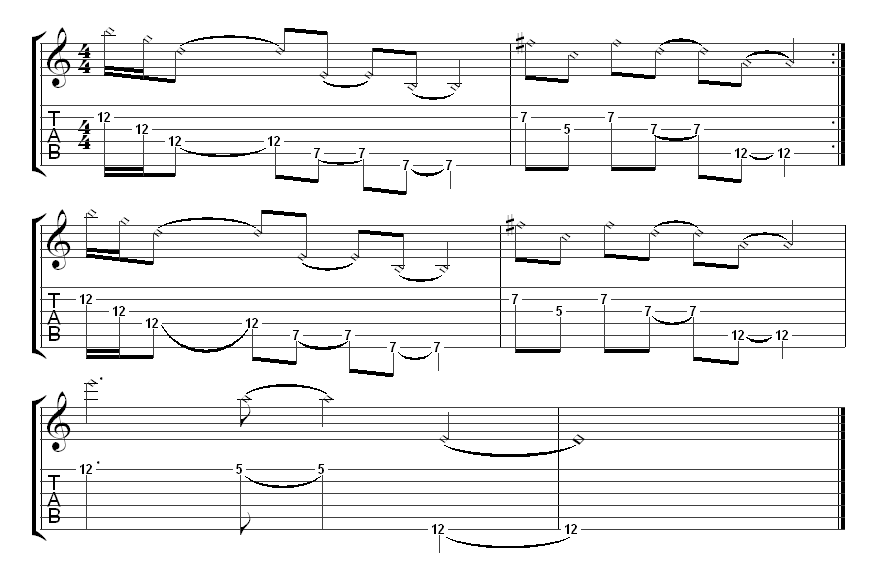
Natural harmonics are the singling out of an overtone from the harmonic range. A normal note may sound like a single pitch but it is really a combination of many overtones which combine to make the one sound. You can play harmonics by lightly touching the strings directly above certain frets. The strongest harmonics are found on the twelfth fret. Touching lightly above the twelfth fret will cause the string to vibrate in two halves which produces a note one octave higher than the open string. Touching a string on the fifth fret will produce a harmonic two octaves higher than the open string. You can tune your guitar using harmonics as the 5th fret of the E string will produce the same note as the harmonic on the 7th fret on the A string and so on for each string with the exception of the G and B strings. An artificial harmonic is a right-hand technique which can produce a harmonic for any fretted note or open string. It requires the string to be touched with a finger or your thumb at the same time that it is picked or plucked. With distortion these artificial harmonics can produce squeals. Artificial harmonics can also be produced by tapping your right hand fingers onto the strings. Harmonics are notated with diamond shaped note heads. Example 14a
Example 14b
Example 14cThe squeals in this video are produced by touching the string with your thumb whilst simultaneously plucking the string. There is a sweet spot for this so it might take some practice at first.
|