|
|
| ||||
|
Jazz encompasses many related styles like dixieland, swing, be-bop, fusion, experimental free jazz and acid jazz. The most prominent element that links these styles is the use of improvisation in composition and performance. Improvisation is the spontaneous creation of music and jazz musicians, through listening and study learn how to combine different melodic, harmonic and rhythmic ideas to use in any situation. The most commonly used rhythms in jazz are swung eighth notes, quarter notes and triplet eighth notes with most jazz standards being driven by the swung eighths feel. Example 32a
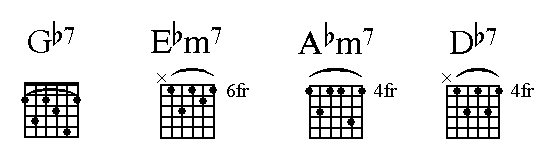
The tempo for this example is fairly fast at 180 BPM. The chord progression is I-VI-II-V progression commonly known as "rhythm changes". Rhythm changes does not actually refer to a change in rhythm but to the song "I've Got Rhythm" which used the same chord progression. This progression is also a common turnaround pattern.
Example 32b
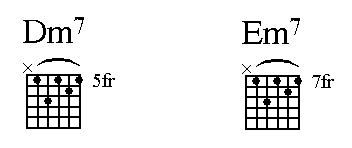
Chord progressions vary as to how many chords are in each bar. Jazz trumpeter Miles Davis was one of the first to write tunes which stayed on the same chord for many bars. This creates a relaxed feel and is known as a modal tune. Example 32b stays on Dmin7 and moves briefly to Emin7 to break it up a little. Notice the bass line under this example as you may need to play additional bass notes if playing solo jazz guitar. A walking bass line gets its name from the predominantly quarter note driven groove that feels like it walks through the progression. Harmonically a walking bass line plays the root note of each chord then uses scale and chord notes to move around the progression to the root note of the next chord. Preceding the root notes of each chord with notes a semitone above or below (or using other leading notes) provides a logical sense of forward motion to the bass line. As this is improvisation, it's your choice which notes you use.
Example 32c
This example is a vamp on an Amin chord using variations from the A dorian mode. Example 32d
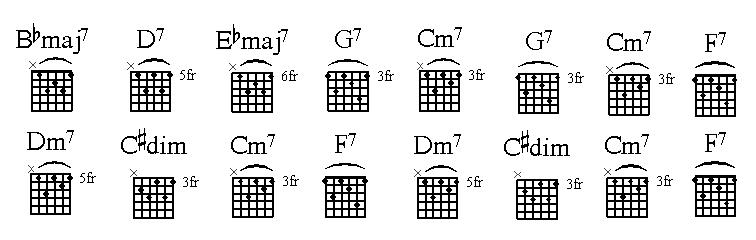
Example 32d uses the chord progression from "Someday my Prince will come". It has three beats per bar yet retains a swing feel. The chord plucking technique allows you to play separate bass notes to create a more interesting rhythm.
Example 32e
This is the Jazz standard "Summertime" by George Gershwin. In a Jazz duo you would do a lot of comping but on your own you would generally be responsible for the melody. Different chord voicings are often required to facilitate playing the melody. In this example the bass line is simplified to focus on the melody. Such considerations will be better served if you develop a wider jazz vocabulary by listening to a lot of Jazz recordings and getting hold of some jazz charts through such publications as the "Real Book". Try jamming over some Jazz grooves in the Session time section. |