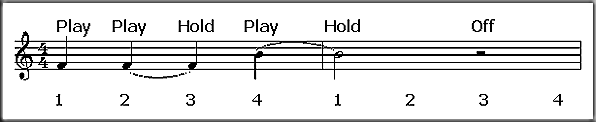
Reading music
The majority of music is written using standard notation as it is one the most common ways for musicians to exchange ideas. The understanding of how pitch, rhythm, articulation, dynamics, etc. can be used within a tune is embellished by the ability to sight-read.
PitchThe word pitch helps us describe a sound, (high pitch/low pitch). In music pitches are given names. The first seven letters of the alphabet act as the names for each pitch (A, B, C, D, E, F, G).
The staffA staff consists of five lines. The notes are placed on the lines and the spaces so each line and each space represents a note.

When a treble clef sign is placed on a staff it indicates where the G note is located.
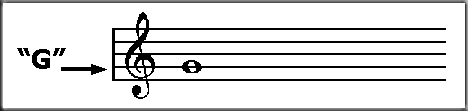

There is an acrostic saying to help you remember the lines of the treble clef (Every Good Boy Deserves Fruit). The notes in between the lines of the stave spell the word "face." (F A C E). These can be helpful as long as they don't confuse the fact that the letter names are simply the alphabet from A to G and then continuing on with A after G.
Ledger linesLedger lines are placed above or below a staff to extend to higher or lower notes. As with the staff, both lines and spaces created by ledger lines can have notes placed on them.

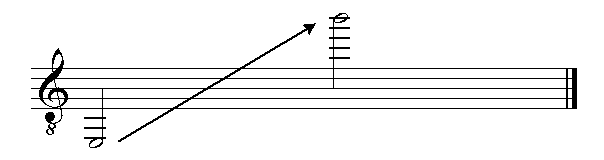
The range of the guitar is fairly large. Electric guitars have a bigger range as they have more frets than classical guitars and those frets are also easier to reach. The following diagram shows the written range of the guitar although higher notes can be produced using harmonics. Also note the small number 8 which is often written below the Treble Clef. This is because guitars sound an octave lower than written.
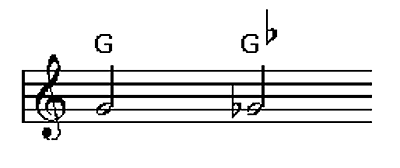
When a sharp or flat sign is placed in front of a note it changes the pitch of that note.
Sharps indicate to raise the note a semitone (fret).
Flats indicate to lower the note a semitone (fret).
Notice that the sharps (#) are written before the note on a music stave and after the note when written as a letter name. This applies to both sharps (#) and flats (b).
The word rhythm helps us to describe the length or duration a note should have. In music rhythms are given names. Each rhythm also has an accompanying rest which can replace that rhythm with silence for the same amount of time.






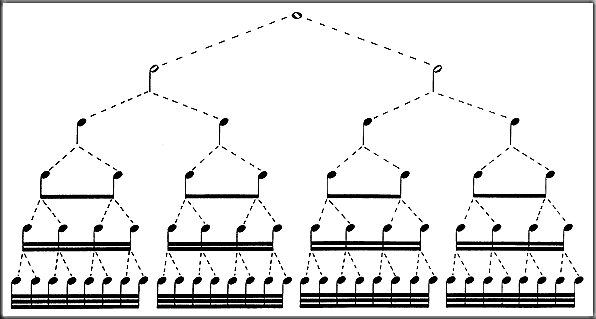
Another way to look at the length of notes is to see them branching out in groups each equalling a bar.
Tempo indicates the speed of a tune. It is usually notated by a crotchet symbol placed at the top left corner of the music indicating the number of beats per minute. This symbol is often called a metronome marking or what you set the "click" to on a sequencer.

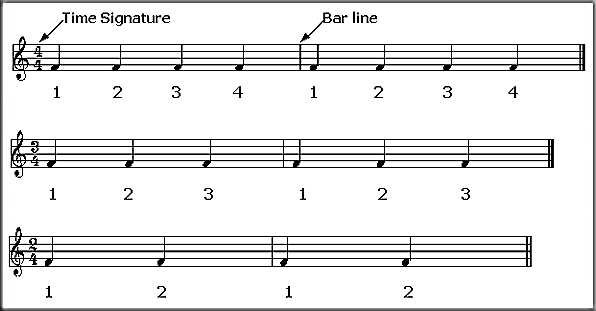
When a time signature is placed at the beginning of a staff (just after a clef) it indicates how many beats are in each bar.
The top number meaning the number beats per bar.
The bottom number meaning the type of rhythm for each beat.
The time signature 4/4 represents 4 quarter note beats per bar.
Underneath each rhythm is a way to count aloud and hear the rhythm's length, just like drummers. The syllables that you say create the sound of each rhythm ("1e+a" or "One-e-an-ah" gives us four syllables to represent the sound of four sixteenths in one beat). Of course you could say any word that gives you the right amount of syllables (e.g. 1 banana 2 banana etc.) as including the main beats within the count helps us to know where we are in the bar.
Here are a few rhythm tapping exercises to start getting used to. Remember to always count aloud and tap when you see the rhythm correspond with the count number. These exercise are designed to have both hands going at the same time. (Right-hand stems up, left-hand stems down). You do not need to play these on your guitar, just tap away on a table or your legs. The whole idea is to start slow and gradually get faster each go, so you can HEAR the rhythms. Notice too that you will be counting the subdivisions of the beats for the faster rhythms.

Try to clap the following rhythms while counting aloud. Remember to hold your hands together for the long ones (whole, half...).



Some notes have dots after them. When a dot is placed after a note it extends the length of that note by half of its original value.

When a note has a curved line connecting it with a note of the same pitch, the note lasts for the duration of these notes combined. This is used to make notes longer and enables notes to cross the barline.