|
|
| ||||
|
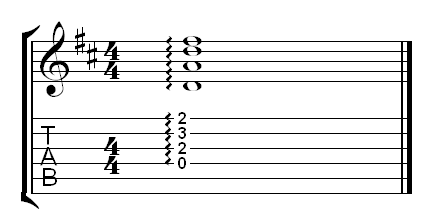
An arpeggio is simply the notes of a chord played one at a time. As there are many different types of chords, you may also want to refer to the section on chord spelling for ideas about which notes to play in an arpeggio. Arpeggios are also known as broken chords. Guitarists and pianists can play them easily by simply forming a chord shape and then playing the notes separately. Arpeggios don't have to be played strictly in an ascending or descending direction. You can use arpeggio notes in any order to achieve the effect you want. Some arpeggios are notated as a chord with the following symbol indicating that the notes are to be played separately: Example 68a
Example 68a is an open D chord. Example 68b
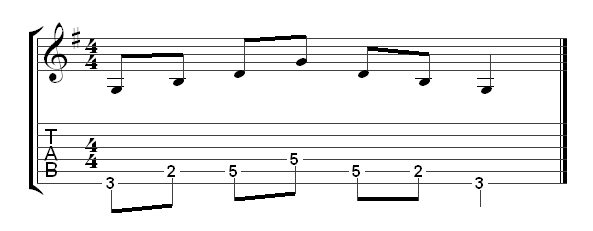
This is a G major arpeggio over one octave.
Example 68c
More complex arpeggios have extra notes in them. This is a Gmaj7 arpeggio over one octave.
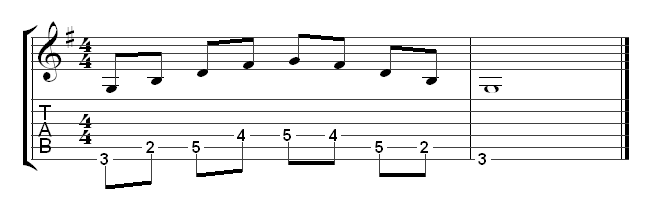
Example 68d
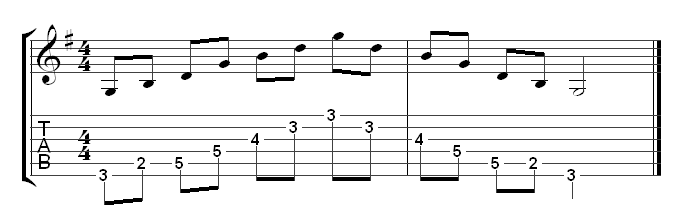
This is a G major arpeggio over two octaves.
Example 68e
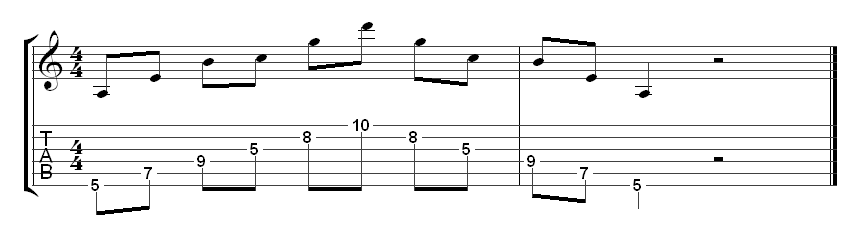
When arpeggios are arranged so that each note is on a different string the sweep picking technique is a logical way to play them. This is an Amin9 arpeggio.
Example 68f
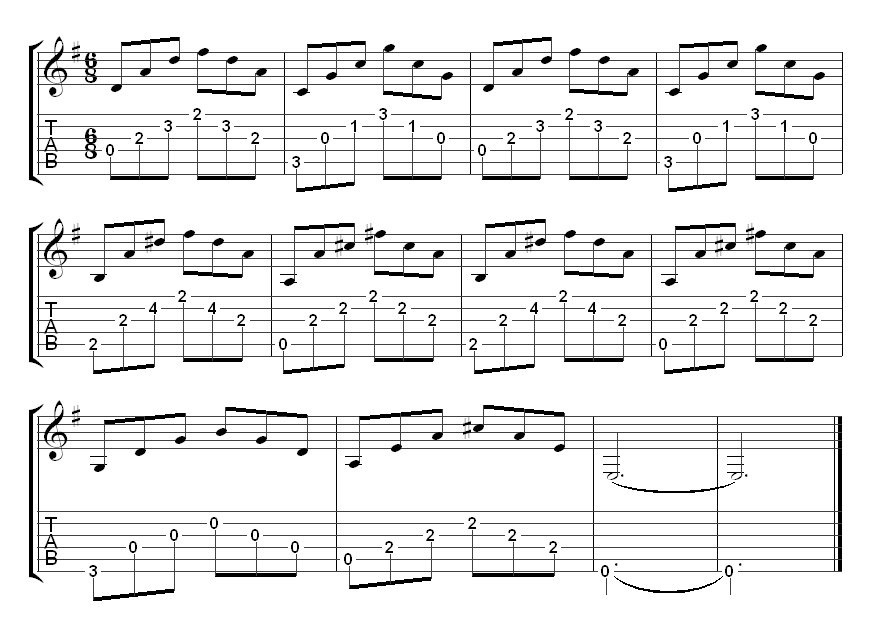
This example is really a series of chord shapes played as arpeggios using the free-stroke technique.
|